
Introduction
Maintenance planning vs scheduling is one of the most misunderstood topics in maintenance organizations.
This misunderstanding is one of the main reasons maintenance systems fail, schedules collapse, and emergency work dominates daily operations.
Maintenance planning and scheduling are two different functions with two different objectives.
When they are confused or combined, even the best CMMS and experienced teams cannot deliver consistent results.
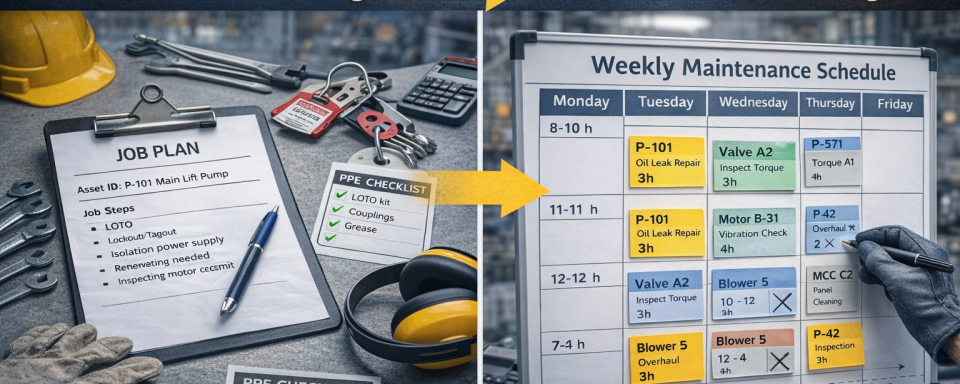
This article explains the real difference between maintenance planning and maintenance scheduling, how each function should operate, and why separating them is essential for effective maintenance execution.
What Is Maintenance Planning?
Maintenance planning is the technical preparation of maintenance work before it is scheduled or executed.
Planning answers one fundamental question:
How should this job be done?
Maintenance planning typically includes:
-
Defining the job scope
-
Identifying required skills and crafts
-
Estimating job duration
-
Identifying tools, materials, and spare parts
-
Identifying safety requirements (LOTO, confined space, permits)
-
Preparing job steps or procedures
Planning is performed ahead of time and without execution pressure.
Its output is a job plan, not a schedule.
What Is Maintenance Scheduling?
Maintenance scheduling is the assignment of planned work to a specific time period based on available resources and operational constraints.
Scheduling answers a different question:
When will this job be done?
Maintenance scheduling considers:
-
Available manpower
-
Shift patterns
-
Equipment availability
-
Operations windows
-
Job priorities
-
Backlog status
Scheduling does not define how the job is done.
It only decides when planned work will be executed.
Scheduling depends entirely on the quality of planning.
Unplanned work cannot be scheduled reliably.
Why the Difference Is Important
When planning and scheduling are confused:
-
Schedules are built on incomplete information
-
Jobs start without materials or permits
-
Technicians wait instead of working
-
Emergency work increases
-
Overtime becomes the default solution
When planning and scheduling are properly separated:
-
Job execution becomes predictable
-
Weekly schedules become realistic
-
Wrench time improves
-
Safety risks are identified earlier
-
Maintenance becomes controlled instead of reactive
How Planning and Scheduling Should Work Together
Step 1: Planning Prepares the Work
Planning prepares:
-
The content of the work
-
The resources required
-
The risks involved
Only planned jobs should move forward.
Step 2: Planned Work Enters the Backlog
Once planned, work orders are placed in the maintenance backlog, awaiting scheduling.
Backlog is a control mechanism, not a problem to eliminate.
Step 3: Scheduling Assigns Time
Scheduling selects work only from the ready backlog and assigns it to a specific week or shift.
This process is explained in detail in weekly scheduling practices.
🔗 [INTERNAL LINK → Article 7: Weekly Maintenance Scheduling – How It Really Works]
Key Elements or Best Practices
The following are industry best practices for separating planning and scheduling:
-
Planning prepares work; scheduling assigns time
-
Planners focus on future work, not today’s execution
-
Schedulers build schedules only from ready work
-
Planning and scheduling roles should not be combined
-
Emergency work should be the exception, not the norm
Common Challenges or Mistakes
Treating the Planner as the Scheduler
This eliminates planning time and forces planners into daily firefighting.
Scheduling Unplanned Work
This guarantees low schedule compliance and execution failure.
Calling Everything an Emergency
When everything is urgent, nothing is controlled.
Ignoring Safety During Planning
Failure to identify safety requirements early leads to delays and unsafe execution, especially in:
-
Pump stations
-
Confined spaces
-
Electrical equipment
-
Chemical handling areas
Conclusion
Maintenance planning and maintenance scheduling are not the same activity.
-
Planning prepares the work
-
Scheduling assigns the time
When these functions are clearly separated and correctly integrated, maintenance execution becomes predictable, safe, and efficient.
This topic is part of the complete maintenance planning and scheduling process.
The system-level maintenance planning principles discussed in this article align with widely recognized maintenance and reliability practices published by SMRP.
