
Introduction
Emergency Sykes pump engine failure is one of the most dangerous breakdowns in sewage pumping stations, especially when the pump is used only during excavation works or urgent situations.
This article is based on a real failure in a sewage station where an emergency Sykes pump suffered a complete engine body crack due to operating without lubricating oil.
The failure was not only caused by poor maintenance planning, but also by operational and communication gaps between operators and maintenance.
What is This Failure?
The failure occurred when the engine driving an emergency sewage pump was started and operated without engine oil, leading to:
-
Severe internal friction
-
Rapid temperature rise
-
Bearing and crankshaft damage
-
Final result: cracked engine block (engine housing failure)
The pump is a diesel-driven emergency unit used only during:
-
Excavation works
-
Bypass pumping
-
Sudden flooding or emergency conditions
Why It Is Important
This type of failure is critical because:
-
❌ Emergency pump becomes unavailable when most needed
-
❌ Complete engine loss (not repairable)
-
❌ High replacement cost
-
❌ Risk of sewage overflow during urgent works
Most importantly:
👉 This failure is 100% preventable.
Standby equipment fails not because it runs too much, but because it is not checked or monitored.
How to Implement / Create
Turning the Failure into a Practical Maintenance & Operation Control
To prevent recurrence, the solution must address three areas:
-
Operator behavior
-
Authority & communication
Practical Actions:
-
Treat emergency pumps as critical assets, not “idle equipment”
-
Create a mandatory Pre-Start Checklist
-
Prohibit operation without mechanical approval
-
Assign responsibility for monitoring during operation
-
Record every start, stop, and runtime
Key Elements or Best Practices
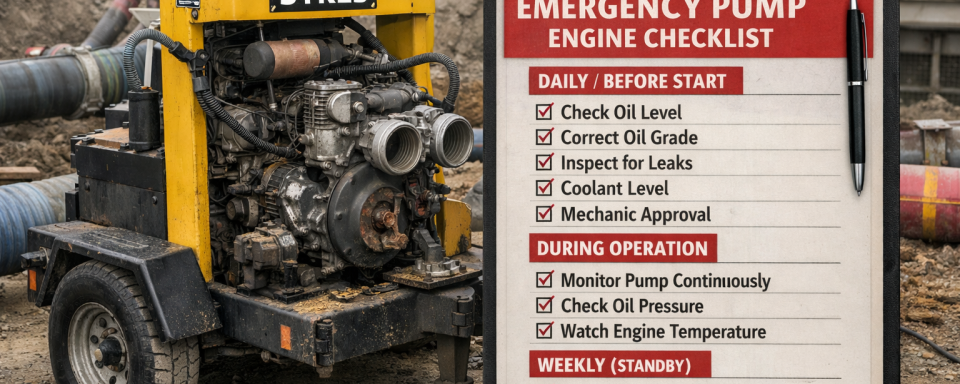
✅ Emergency Sykes Pump – Engine Checklist
Daily / Before Start Checklist (Mandatory)
-
Check engine oil level using dipstick
-
Confirm correct oil grade
-
Inspect for oil leakage under engine
-
Confirm coolant level
-
Ensure mechanical technician approval before start
-
Log inspection (date / name / signature)
During Operation Checklist
-
Operator assigned to monitor pump continuously
-
Monitor engine sound and vibration
-
Watch oil pressure and temperature (if available)
-
Do NOT leave pump running unattended
Weekly (Even if Not Used)
-
Visual inspection of engine
-
Manual engine rotation (if applicable)
-
Check oil condition (color / smell)
-
Verify emergency pump availability status
Monthly
-
Test run under supervision
-
Review oil consumption or leakage
-
Update PM records and runtime hours
Common Challenges or Mistakes
1. “It’s Only a Standby Pump”
Standby pumps are often ignored until an emergency — exactly when failure is unacceptable.
2. Operators Do Not Monitor the Pump
Starting the pump and leaving the area is a common and dangerous practice.
3. Starting the Pump Without Mechanical Approval
In this case, operators started the pump:
-
Without inspection
-
Without checking oil
-
Without informing the responsible mechanic
This is a system failure, not an individual mistake.
4. No Clear Responsibility
No defined answer to:
“Who is responsible for this pump while it is running?”
Conclusion
This emergency Sykes pump engine failure was not a technical mystery.
It was the result of:
-
Poor maintenance planning
-
Lack of operator monitoring
-
Unauthorized operation without mechanical checks
Emergency pumps must be managed with stricter control, not less.
A simple checklist, clear authority, and continuous monitoring would have prevented a total engine loss.
This failure should be used as a training case study for operators and maintenance teams in sewage stations.
