
Introduction
In many maintenance organizations, the term maintenance backlog is misunderstood and poorly managed.
Some teams see the backlog as a problem to eliminate, while others allow it to grow uncontrollably without understanding its purpose.
A properly managed maintenance backlog is not a sign of failure.
It is a control tool that connects planning, scheduling, and execution.
This article explains what a maintenance backlog really is, the difference between planned and ready backlog, and how backlog mismanagement leads directly to schedule failure and reactive maintenance.
What Is a Maintenance Backlog?
The maintenance backlog is the total amount of approved maintenance work that has not yet been executed.
It represents:
-
Future work demand
-
Planning workload
-
Scheduling options
A backlog is not just a list—it is a time-based control mechanism.
Backlog exists because maintenance work must be:
-
Planned before execution
-
Coordinated with operations
-
Matched to available resources
This concept sits directly downstream of the maintenance planning and scheduling process.
Why the Maintenance Backlog Is Important
When the backlog is understood and controlled:
-
Schedulers can build realistic weekly schedules
-
Planners can work ahead instead of firefighting
-
Management gains visibility of workload vs capacity
-
Emergency work is reduced
When the backlog is ignored or misused:
-
Scheduling becomes guesswork
-
Priorities are overridden daily
-
Overtime increases
-
Maintenance remains reactive
In utilities and wastewater facilities, backlog visibility is critical due to:
-
Continuous operation
-
Limited shutdown windows
-
Safety and environmental risks
Types of Maintenance Backlog
1. Planned Backlog
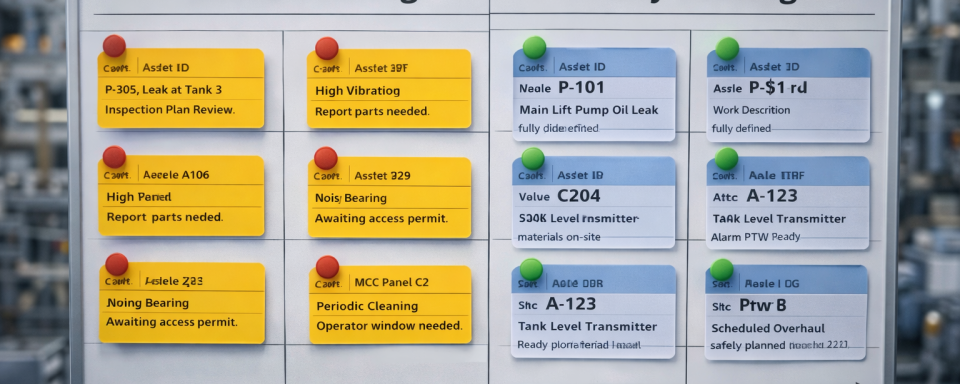
The planned backlog includes work orders that:
-
Are approved
-
Are technically defined
-
Have been reviewed by planning
However, they may still be missing:
-
Materials
-
Permits
-
Access windows
Planned backlog represents future planning demand.
2. Ready Backlog
The ready backlog is a subset of the planned backlog.
Work orders in the ready backlog are:
-
Fully planned
-
Material-ready
-
Technically clear
-
Safe to schedule
Only work from the ready backlog should be scheduled.
This separation is critical for effective weekly scheduling.
🔗 [INTERNAL LINK → Article 7: Weekly Maintenance Scheduling – How It Really Works]
How to Control the Maintenance Backlog
Step 1: Define Backlog Entry Rules
A work order should not enter the backlog unless it is:
-
Approved
-
Properly classified
-
Technically meaningful
Poor-quality work orders damage backlog credibility.
🔗 [INTERNAL LINK → Article 5: Minimum Work Order Information for Effective Maintenance Planning]
Step 2: Separate Planned and Ready Backlog
Do not mix:
-
Unplanned work
-
Planned but incomplete work
-
Ready-to-schedule work
Each category serves a different control purpose.
Step 3: Measure Backlog in Time, Not Number
Backlog should be measured in:
-
Labor hours
-
Crew weeks
Example:
-
4 weeks of ready backlog = healthy
-
12+ weeks = planning bottleneck or resource mismatch
Step 4: Protect the Backlog from Daily Disruptions
Emergency work should not erase backlog discipline.
True emergencies are handled separately and reviewed after execution.
Key Elements or Best Practices
The following are industry best practices for backlog management:
-
Separate planned and ready backlog
-
Schedule only from the ready backlog
-
Maintain 3–6 weeks of ready backlog (typical range)
-
Review backlog weekly
-
Use backlog trends, not snapshots
Common Challenges or Mistakes
Treating Backlog as a KPI to Minimize
Zero backlog usually means no planning.
Scheduling Directly from Unplanned Work
This guarantees poor schedule compliance.
Using Backlog to Hide Resource Problems
Backlog exposes problems—it should not be manipulated.
Many of these failures are symptoms of deeper planning system issues.
🔗 [INTERNAL LINK → Article 9: Why Maintenance Planning Fails in Real Plants]
Conclusion
The maintenance backlog is not an administrative list.
It is a control mechanism that connects planning, scheduling, and execution.
When backlog is structured and disciplined:
-
Planning becomes proactive
-
Scheduling becomes realistic
-
Maintenance performance improves sustainably
Without backlog control, maintenance will always remain reactive.
This topic is part of the complete maintenance planning and scheduling process.
The system-level maintenance planning principles discussed in this article align with widely recognized maintenance and reliability practices published by SMRP
