
Introduction
Poor maintenance planning rarely starts in the planning office.
In most plants, the root cause is incomplete or low-quality work orders that reach planners with missing, vague, or incorrect information.
Without minimum work order information, planners are forced to guess:
-
Job scope
-
Required skills
-
Materials
-
Duration
-
Safety requirements
This article explains the minimum work order information required for effective maintenance planning, why each element matters, and how missing data directly leads to reactive work and schedule failure.
What Is Minimum Work Order Information?
Minimum work order information refers to the essential data that must exist before a work order can be planned.
It does not mean:
-
Long descriptions
-
Perfect technical reports
-
Over-documentation
It means enough accurate information to allow a planner to prepare a reliable job plan.
Why It Is Important
When work orders lack minimum information:
-
Job plans are incomplete or wrong
-
Materials are missed
-
Safety hazards are discovered during execution
-
Schedules fail
-
Emergency work increases
In utilities and wastewater facilities, poor work order quality increases risk due to:
-
Confined spaces
-
H₂S or chlorine exposure
-
Continuous operation constraints
Good planning is impossible without good input.
Minimum Work Order Information Required
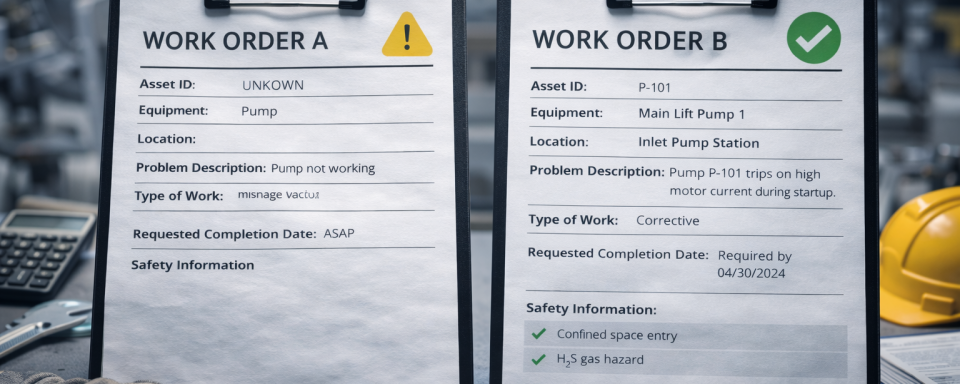
1. Equipment Identification
Every work order must clearly identify:
-
Asset tag or ID
-
Equipment name
-
Location (pump station, tank, MCC, etc.)
Without this, planners cannot:
-
Check history
-
Verify spare parts
-
Assess criticality
2. Clear Problem or Task Description
The description should answer:
-
What is wrong?
-
What was observed?
-
Under what conditions?
❌ “Pump not working”
✅ “Pump P-101 trips on high motor current during startup”
3. Type of Work
Each work order must be classified correctly:
-
Corrective
-
Preventive
-
Inspection
-
Improvement
Incorrect classification distorts backlog and scheduling decisions.
4. Requested Completion Time (Not Priority Abuse)
Requesters should indicate:
-
Required by date
-
Operational constraints
Priority should be assigned through a defined priority system, not emotion or noise.
5. Safety and Access Information
Minimum safety information may include:
-
Confined space entry required
-
Electrical isolation needed
-
Chemical or gas hazards
-
Access limitations
Final safety controls must always comply with site HSE procedures and local regulations.
6. Supporting Information (When Available)
Optional but valuable inputs:
-
Photos
-
Alarm history
-
Operator notes
-
Previous failures
These greatly improve planning accuracy and reduce site visits.
How to Implement Minimum Work Order Standards
Step 1: Define Mandatory Fields in the CMMS
Configure CMMS so work orders cannot proceed without:
-
Equipment ID
-
Problem description
-
Work type
Step 2: Train Operators and Requesters
Most poor work orders are not intentional.
Short training on what planners need improves quality dramatically.
Step 3: Reject and Return Poor Work Orders
Planners should not “fix” bad requests.
Returning poor work orders:
-
Improves discipline
-
Protects planner time
-
Improves long-term quality
Key Elements or Best Practices
The following are industry best practices for work order quality:
-
Define minimum required fields
-
Use clear problem descriptions
-
Separate request date from priority
-
Capture safety information early
-
Do not allow planning on incomplete work orders
Common Challenges or Mistakes
Allowing Verbal or WhatsApp Requests
Untracked work destroys planning discipline.
Letting Planners “Fix” Bad Work Orders
This hides system problems and overloads planners.
Treating Work Orders as Administrative Forms
Work orders are technical inputs, not paperwork.
Conclusion
Effective maintenance planning starts before planning begins.
When work orders contain minimum, accurate information:
-
Job plans improve
-
Schedules stabilize
-
Safety risks are identified early
-
Reactive work is reduced
Without disciplined work order inputs, even the best planners and CMMS systems will fail.
This topic is part of the complete maintenance planning and scheduling process.
The system-level maintenance planning principles discussed in this article align with widely recognized maintenance and reliability practices published by SMRP.
