
Introduction
Schedule compliance is one of the most widely used maintenance KPIs—and one of the most misunderstood.
Many organizations report high schedule compliance percentages while still struggling with frequent breakdowns, excessive overtime, constant rescheduling, and frustrated supervisors and technicians.
The problem is not the metric itself. Instead, the problem lies in how this indicator is interpreted and used.
This article explains what this metric really tells you, what it does not tell you, and how misleading results can hide deeper planning and scheduling failures within the maintenance system.
What Is Schedule Compliance?
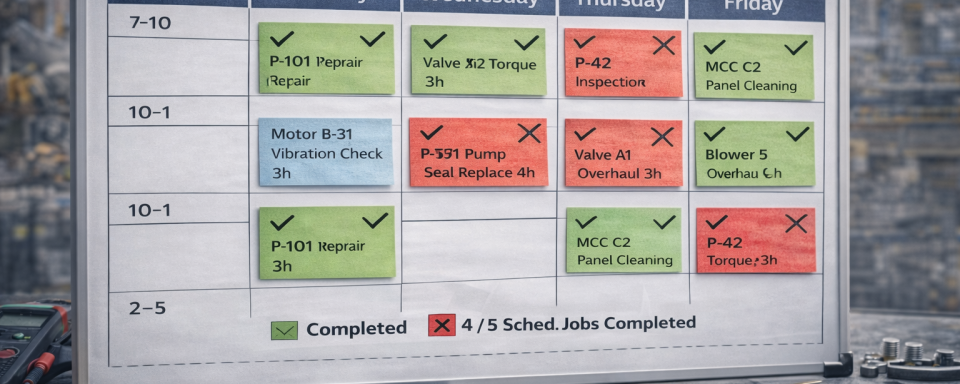
Schedule compliance measures how much of the scheduled maintenance work was completed as planned within a defined time period.
In simple terms, it answers one question:
Did we complete the work we committed to for this week?
Maintenance teams typically calculate this indicator as:
Scheduled work completed ÷ Scheduled work planned
However, while this formula appears straightforward, it hides several pitfalls that can easily distort the results.
This indicator reflects execution discipline, not planning quality or asset reliability.
Why Schedule Compliance Is Important
When used correctly, this metric helps maintenance organizations to:
-
Measure execution discipline
-
Reveal whether schedules are realistic
-
Identify operational disruptions
-
Support continuous improvement efforts
On the other hand, when misused, this indicator can:
-
Encourage manipulation of schedules
-
Hide planning and backlog problems
-
Penalize supervisors unfairly
-
Create false confidence in maintenance performance
This metric only has value when the weekly schedule itself is realistic and protected.
For this reason, it sits directly downstream of weekly maintenance scheduling.
What Good Schedule Compliance Actually Indicates
High-quality results usually indicate that:
-
Work was selected from the ready backlog
-
Job plans were complete and accurate
-
Materials and permits were available
-
Operations honored the agreed schedule
-
Emergency work was controlled
As a result, this indicator reflects system health, not individual effort.
A stable maintenance system will naturally produce consistent and repeatable results.
What Schedule Compliance Does NOT Tell You
This indicator does not show:
-
Whether the right work was scheduled
-
Whether maintenance activities improved reliability
-
Whether preventive maintenance was effective
-
Whether failure causes were eliminated
For example, a plant can achieve 95% compliance and still remain:
-
Highly reactive
-
Poorly planned
-
Reliability-challenged
Strong numbers alone do not guarantee effective maintenance.
Common Ways Schedule Compliance Is Manipulated
1. Rescheduling Work to Protect the Number
Moving work out of the schedule before execution artificially inflates results and hides planning or resource problems.
2. Scheduling Only Easy Jobs
Excluding complex or high-risk jobs makes schedules easier to complete. However, this approach removes real operational value.
3. Treating Emergencies as Scheduled Work
Adding emergency jobs to the schedule after completion destroys metric integrity. Maintenance teams must track emergencies separately.
4. Freezing Unrealistic Schedules
Freezing a poor schedule does not make it realistic. Discipline must be built on proper planning inputs.
How to Use Schedule Compliance Correctly
Step 1: Protect the Weekly Schedule
This indicator becomes meaningful only when:
-
The schedule is frozen
-
Changes are limited to true emergencies
Step 2: Separate Emergency Work
Maintenance teams must track emergency work outside the compliance calculation to preserve accuracy.
Step 3: Analyze Reasons for Non-Compliance
Instead of asking “Who failed?”, ask:
-
Was the job unready?
-
Were materials missing?
-
Did operations change priorities?
-
Was the duration underestimated?
Step 4: Use Trends, Not Single Results
In practice, one week of data means nothing.
Trends reveal:
-
System stability
-
Planning maturity
-
Organizational discipline
Safety and Schedule Compliance
Poor execution discipline often leads to:
-
Rushed work
-
Bypassed permits
-
Incomplete isolations
-
Increased safety incidents
Therefore, safety must never be compromised to protect performance numbers.
Final safety controls must always comply with site HSE procedures and local regulations.
Key Elements or Best Practices
Industry best practices for using this metric include:
-
Measuring only frozen schedules
-
Scheduling only ready work
-
Separating emergency work
-
Using results as a diagnostic tool
-
Linking non-compliance to system causes
-
Avoiding the use of compliance as a punishment metric
Common Challenges or Mistakes
Using the Metric as a Performance Weapon
This approach destroys trust and encourages manipulation.
Ignoring Planning Quality
Poor planning will always result in weak execution discipline.
Chasing the Number Instead of the Cause
A good number produced by a weak system is dangerous.
Many of these issues indicate broader maintenance planning failures.
Conclusion
Schedule compliance is not a success metric by itself.
Instead, it acts as a mirror that reflects how well planning, backlog management, scheduling, and execution work together as a system.
When interpreted correctly:
-
It drives improvement
-
Exposes system weaknesses
-
Supports reliable maintenance execution
When misused:
-
It hides failure
-
Punishes the wrong people
-
Delays real improvement
This topic is part of the complete maintenance planning and scheduling process.
The concepts discussed in this article align with widely recognized maintenance performance measurement principles published by SMRP.
