
Introduction
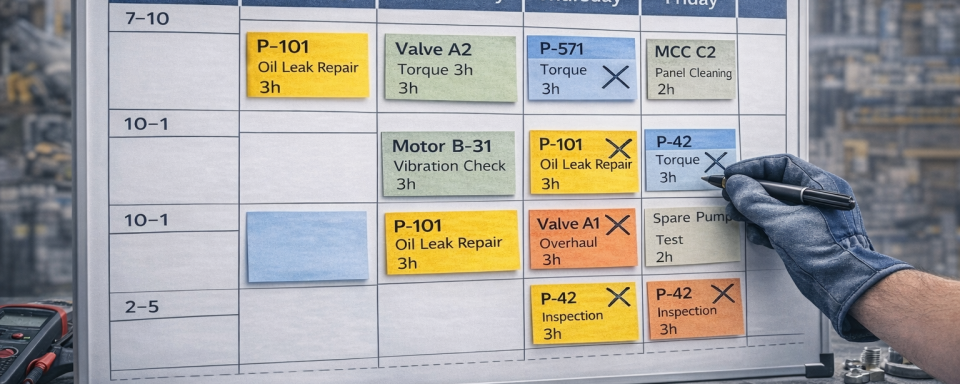
Weekly maintenance scheduling is where most maintenance planning systems either succeed or collapse.
Many organizations believe they are “scheduling” work, while in reality they are only reacting to daily issues and shifting work orders from one day to another.
A weekly maintenance schedule is not a wish list.
It is a commitment between maintenance and operations based on planned, ready work and realistic resource availability.
This article explains how weekly maintenance scheduling really works, what inputs are required, how the process should be executed, and why most schedules fail in real plants.
What Is Weekly Maintenance Scheduling?
Weekly maintenance scheduling is the process of assigning ready maintenance work to a specific week based on:
-
Available labor
-
Operational constraints
-
Equipment availability
-
Safety and access conditions
It answers one clear question:
What maintenance work will be executed next week?
Scheduling does not define job content.
It only assigns time and sequence to work that has already been planned.
This activity sits directly downstream of the maintenance planning and scheduling process.
Why Weekly Maintenance Scheduling Is Important
Without a disciplined weekly schedule:
-
Daily priorities constantly change
-
Technicians wait for instructions
-
Supervisors firefight instead of managing
-
Planned work is repeatedly delayed
-
Emergency work dominates the week
Effective weekly maintenance scheduling:
-
Improves schedule compliance
-
Stabilizes daily execution
-
Reduces overtime
-
Improves coordination with operations
-
Converts planning effort into completed work
In utilities and wastewater facilities, weekly scheduling is especially critical due to:
-
Continuous operation
-
Limited shutdown windows
-
Safety and environmental risks
Inputs Required for Weekly Maintenance Scheduling
1. Ready Maintenance Backlog
Only work from the ready backlog should be scheduled.
Ready backlog work orders are:
-
Fully planned
-
Material-ready
-
Technically clear
-
Safe to execute
Scheduling unready work guarantees failure.
2. Available Labor Capacity
Scheduling must be based on real available hours, not headcount.
Consider:
-
Vacations and training
-
Shift patterns
-
Overtime limits
-
On-call assignments
Overloading the schedule destroys credibility.
3. Operations Constraints
Weekly schedules must be aligned with:
-
Equipment availability
-
Process shutdown windows
-
Permit and safety constraints
-
Production priorities
A schedule built without operations input will not survive the week.
How Weekly Maintenance Scheduling Should Be Done
Step 1: Prepare the Draft Schedule
The scheduler prepares a draft weekly schedule using:
-
Ready backlog
-
Labor availability
-
Job priorities
This draft is not final.
Step 2: Conduct the Weekly Scheduling Meeting
The weekly scheduling meeting typically includes:
-
Maintenance planner or scheduler
-
Maintenance supervisor
-
Operations representative
The objective is to:
-
Confirm equipment availability
-
Resolve conflicts
-
Agree on the final work list
This meeting converts a draft into a commitment.
Step 3: Freeze the Weekly Schedule
Once agreed:
-
The weekly schedule is frozen
-
Changes are limited to true emergencies
-
Deviations are tracked
Freezing the schedule is essential for performance measurement.
Step 4: Execute and Control the Week
During execution:
-
Supervisors work to the schedule
-
Emergencies are handled separately
-
Deviations are recorded, not hidden
Safety Considerations During Scheduling
Safety requirements must be confirmed before scheduling, including:
-
Permit availability
-
Confined space coordination
-
Electrical isolation windows
-
Chemical and gas hazards
-
Lifting and access constraints
Final controls must always comply with site HSE procedures and local regulations.
Key Elements or Best Practices
The following are industry best practices for weekly maintenance scheduling:
-
Schedule only ready work
-
Base schedules on real capacity
-
Involve operations
-
Freeze the schedule
-
Track schedule compliance
-
Separate emergencies from planned work
Common Challenges or Mistakes
Scheduling Unplanned Work
This leads to constant rescheduling and poor execution.
Overloading the Schedule
A full paper schedule guarantees failure in reality.
Allowing Daily Priority Changes
This destroys schedule discipline.
Confusing Scheduling with Dispatching
Scheduling is weekly; dispatching is daily.
Conclusion
Weekly maintenance scheduling is the bridge between planning and execution.
When done correctly:
-
Planning effort turns into completed work
-
Execution becomes predictable
-
Coordination improves
-
Maintenance performance stabilizes
This topic is part of the complete maintenance planning and scheduling process.
The weekly maintenance scheduling practices described in this article are aligned with widely recognized maintenance planning and scheduling principles published by SMRP.
